


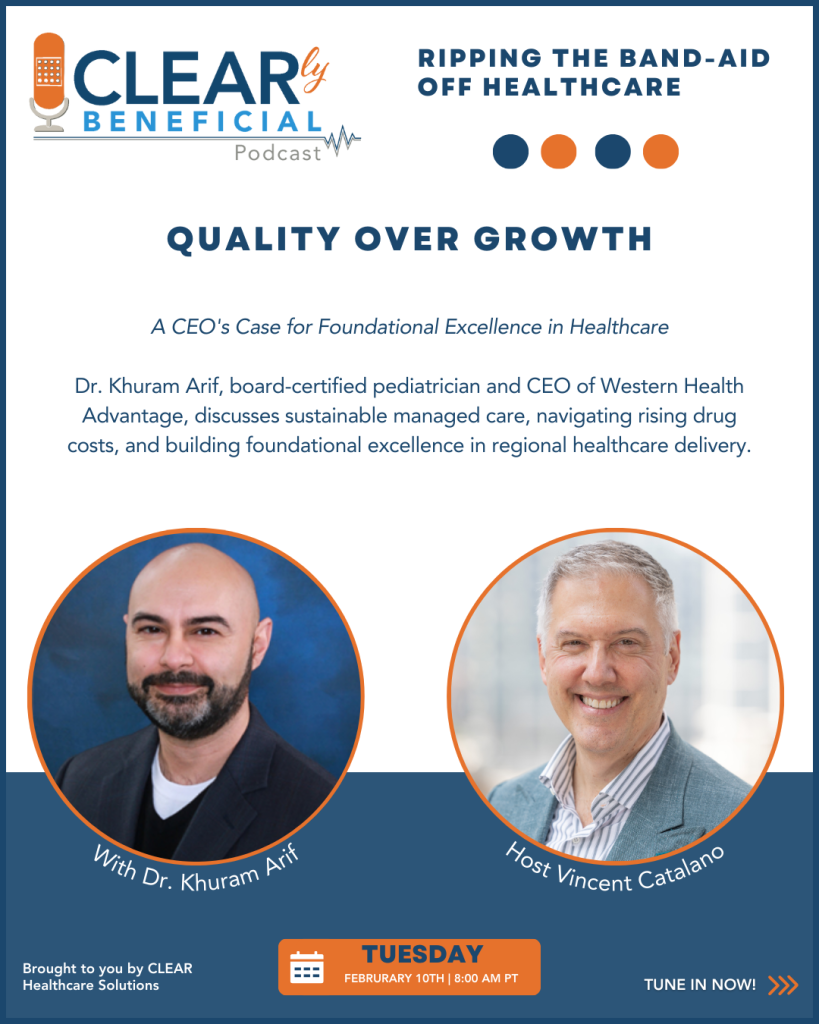
Clip of Vincent Catalano and Dr. Khuram Arif, CEO of Western Health Advantage talking about ‘Healthcare Quality over Growth’.
Tune into the CLEARly Beneficial podcast with host Vincent Catalano and guest Dr. Khuram Arif. Listen on Buzzsprout, Substack, YouTube or any of your favorite podcast channels.
Healthcare Quality Over Growth: A CEO’s Case for Foundational Excellence in Healthcare
A conversation with Dr. Khuram Arif, CEO of Western Health Advantage
Drug costs used to consume about 15% of your health insurance premium.
Today? Over one-third.
That’s not a gradual increase. That’s a crisis that’s fundamentally reshaping how healthcare organizations operate—and what you pay for coverage.
Dr. Khuram Arif, CEO of Western Health Advantage (WHA), joined the CLEARly Beneficial Podcast to discuss how his regional HMO is navigating this cost explosion while maintaining the quality-first approach that makes them successful.
What makes this conversation particularly valuable? Dr. Arif isn’t just a healthcare executive. He’s a board-certified pediatrician who practiced for 19 years, worked at a Federally Qualified Health Center in rural New Mexico, and spent a decade in physician leadership before taking the helm at Western Health Advantage (WHA). He understands healthcare from the exam room to the boardroom.
The Numbers Behind the Premium Shock
“What I would say is overall drug costs are increasing very rapidly. It has been the number one cost driver across the nation,” Dr. Arif explains. “In general, drug costs were, let’s say, 15% of overall premium cost a couple of decades ago. Now it’s over a third.”
That shift didn’t happen by accident. The rise of GLP-1 medications for weight management, breakthrough gene therapies, and specialty pharmaceuticals has created unprecedented pressure on health plans.
But here’s what separates WHA’s approach from many national carriers: they’re not just passing costs through to members. They’re actively working with physicians to find equally effective alternatives, educating providers about medication costs, and negotiating aggressively with pharmaceutical companies.
“You can actually have conversations with providers, you can work with them, you can collaborate with them on building the right kind of tools,” Dr. Arif notes. “Whereas if you’re a big national carrier, you’re working with lots of different entities across the country. You don’t have the same relationships.”
When $30 Million Per Bed Doesn’t Add Up
Vincent Catalano shared an observation from his daily walks through East Sacramento: watching the new UC Davis Medical Center towers rise, knowing the project costs approximately $30 million per hospital bed.
Dr. Arif’s response cuts to the core of healthcare’s infrastructure challenge:
“If you think about those kinds of staggering costs around fixed facilities, hospitals, you have to think, well, what’s the breakeven point? How many years does this bed have to function and at what cost to pay that off? The math is not doable. It’s not realistic, it’s not practical.”
This isn’t about criticizing hospitals. It’s about acknowledging that the traditional hospital-centric model faces economic realities that can’t be ignored.
Seismic retrofitting requirements, regulatory compliance, labor costs—all of these push facility expenses higher. Which means the system needs to evolve.
“A lot of care now with the help of technology can happen at home. A lot of care can happen in the clinic. A lot of care can happen at freestanding ambulatory surgical centers,” Dr. Arif explains. “If you can get care at the most efficient level, you can hopefully try and start to decrease some of those costs.”
The Hidden Gem Strategy: Why WHA Chooses Quality Over Growth
Most healthcare organizations chase expansion. Bigger service areas. More members. Rapid growth.
WHA is deliberately choosing a different path.
“Expansion is glamorous. It’s great. We’ve done it before. We’ve had to kind of pull back,” Dr. Arif says candidly. “So let’s do business where we can do it well and keep the quality high and keep innovating and optimizing it.”
This isn’t risk aversion. It’s strategic discipline.
WHA operates across 10 counties in Northern California, serving over 100,000 members. When hospital systems approach them about expansion, the answer isn’t automatic. They need to meet WHA’s efficiency standards first.
“I’d rather that we keep delivering the value that we offer in spades and not go crazy trying to expand if you cannot assure that you can keep costs under control,” Dr. Arif explains.
The organization even has a name for this approach: the “Plan for Foundational Excellence.”
What Happens When 300 Employees Design Your Strategy
Most strategic plans come from the C-suite. Consultants get hired. Leadership teams retreat to off-sites. Then the plan gets rolled out to staff.
WHA flipped that model.
“We asked them, what can we do better? You guys are doing the work every day. Tell us leadership, what should the strategy be?” Dr. Arif recalls.
The answer from 300 staff members across the organization? Focus on the fundamentals.
“We heard across the board, our core job, which is to deliver good health insurance product at a good price with a really, really high customer level of support, we need to do that better.”
Not expansion for expansion’s sake. Not chasing new lines of business. Not copying what big national carriers are doing.
Instead: break down silos, strengthen core operations, improve customer support, and excel at what makes WHA valuable in the first place.
Innovation That Actually Reduces Costs
WHA was the first health plan in California to offer covered nutrition services.
That wasn’t a splashy announcement designed to win awards. It came from physicians asking, “Can you cover this? It’s innovative. We’re seeing our patients struggle with this.”
The organization sat down as a team, evaluated the evidence, and made the coverage decision—before GLP-1 weight loss medications became the default solution.
Now they’re implementing AI tools, but with the same thoughtful approach.
“We have an AI steering committee with a whole company hands-on approach to help guide us,” Dr. Arif explains. The goal isn’t to chase every shiny new technology. It’s to reduce administrative waste so premiums can stay reasonable.
Ambient AI for clinical documentation. Automated tools that reduce physician burnout. Technology that streamlines rather than complicates.
“Not because we want to inflate our profits, but because we want to keep our premiums at a reasonable level,” Dr. Arif states.
Care Navigation: The “Non-Flashy” Solution That Actually Works
One of the most powerful tools WHA offers isn’t flashy technology or breakthrough treatments.
It’s helping members figure out where to get care.
The emergency room when you need urgent care? A specialist when primary care would suffice? An expensive hospital system when a freestanding facility would work just as well?
These decisions have massive cost implications—and most members don’t have the information to make them effectively.
“How does one decide where’s the most efficient place to get care?” Dr. Arif asks. That’s where care navigation becomes critical.
It’s not about restricting access. WHA actually emphasizes that members maintain broad choice. It’s about providing the support and information people need to make good decisions.
The Physician Partnership Model
Dr. Arif’s clinical background shapes how WHA works with providers.
When they talk about medication costs with physicians, it’s not an adversarial conversation. It’s collaborative education about alternatives that work just as well but cost less.
When they evaluate new coverage requests, they’re listening to what physicians see in their practices.
When they implement technology, they’re thinking about how it affects the physician-patient relationship.
“We have to think about healthcare holistically, not just at the consumer end, but everything that goes up and down the supply chain to really understand how to make the system more efficient,” Dr. Arif explains.
That includes addressing physician shortages through residency programs, building trust with provider partners, and ensuring that efficiency improvements don’t come at the expense of quality care.
Why This Approach Matters for Everyone
You might not be a WHA member. You might not even live in Northern California.
But the challenges Dr. Arif describes, exploding drug costs, unsustainable infrastructure expenses, the tension between growth and quality, these affect every health plan and every person with insurance.
The WHA model demonstrates that there’s an alternative to the “growth at all costs” approach dominating healthcare. You can:
- Maintain stable premiums while managing rising costs
- Build strong provider partnerships instead of adversarial relationships
- Invest in care navigation that actually helps members
- Implement innovation thoughtfully rather than chasing every trend
- Develop strategy from the bottom up rather than top down
- Choose quality and sustainability over rapid expansion
“It’s a huge responsibility,” Dr. Arif acknowledges. “We have 100,000 plus members who depend on us for their care. So how do we continue to navigate this well for them? We can’t do this alone. So we need all of our partners at the table.”
That collaborative mindset with members, providers, staff, and community partners might be the most important lesson of all.
In a healthcare system obsessed with scale and growth, WHA’s focus on quality and sustainability might be the most revolutionary approach of all.
Listen to the full conversation with Dr. Khuram Arif on The CLEARly Beneficial Podcast:
- Buzzsprout: https://www.buzzsprout.com/2526095/episodes/18632345
- Substack: https://clearlybeneficialpodcast.substack.com/
- YouTube: https://www.youtube.com/@CLEARlyBeneficialPodcast
New episodes release every Tuesday at 8:00 AM.
About Dr. Khuram Arif
Dr. Khuram Arif is the Chief Executive Officer of Western Health Advantage (WHA), a regional HMO serving over 100,000 members across 10 counties in Northern California. He is a board-certified pediatrician with 19 years of clinical practice experience and a decade in physician leadership. Dr. Arif holds an MBA from UC Davis, is a Certified Physician Executive with the American Association of Physician Leadership, and is a Fellow of the Academy of Healthcare Management at America’s Health Insurance Plans. Learn more at www.westernhealth.com.
About Vincent Catalano & The CLEARly Beneficial Podcast
Vincent Catalano is the CEO of CLEAR Healthcare Solutions and host of The CLEARly Beneficial Podcast. With over 21 years of experience in employee benefits and insurance brokerage, Catalano brings independent, unbiased insights to healthcare benefits consulting. The podcast features solution-oriented conversations with healthcare innovators, industry leaders, and benefits professionals, targeting brokers, HR professionals, and employers. Learn more at www.clearhcs.com.
Disclaimer: The content provided in this podcast and blog post is for informational purposes only and does not constitute legal, financial, or professional advice. Listeners and readers should consult with qualified professionals regarding their specific situations.