


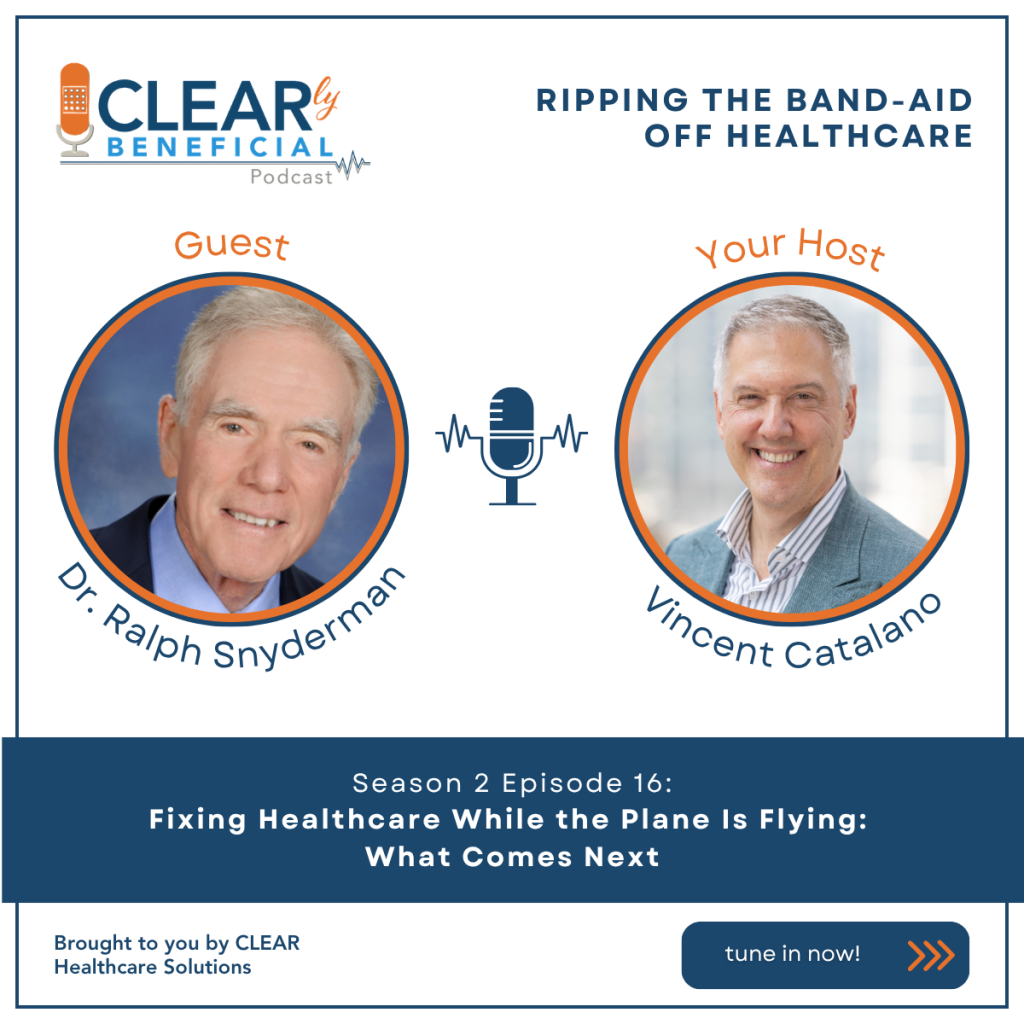
Fixing Healthcare While the Plane Is Flying
Clip of Dr. Ralph Synderman talking about how “Healthcare Is in a Necessary Chaos”.
Tune into the CLEARly Beneficial podcast with host Vincent Catalano. Listen to this episode on Buzzsprout, Substack, YouTube or your favorite podcast channel.
A conversation with Dr. Ralph Snyderman, Chancellor Emeritus of Duke University and Founder of Zeal Care
The bill arrives before the diagnosis sinks in.
That is the American healthcare experience for millions of people. A system that was built to respond to crises has spent decades creating them instead, driving an epidemic of preventable chronic disease, eating through employer budgets at a pace that cannot be sustained, and leaving patients to navigate an impossibly complex maze at the worst moments of their lives.
Dr. Ralph Snyderman has spent his career inside that system and has been trying to change it for longer than most people in the industry have been paying attention. As Chancellor for Health Affairs at Duke University for 16 years and the founding President and CEO of the Duke University Health System, he has run one of the largest integrated academic health systems in the country. He has seen what works, what doesn’t, and precisely why the gap between those two things keeps costing everyone.
He joined Vincent Catalano, host of the CLEARly Beneficial Podcast, for a wide-ranging conversation about what American healthcare actually requires to change, not in theory but in practice, and why a groundbreaking experiment in Arkansas may be the most important model in the country right now.
The Healthcare System That Built the Problem
To understand where healthcare needs to go, Dr. Snyderman starts with where it came from.
For decades, American healthcare operated on a simple and deeply flawed logic: the more you do, the more you get paid. Fee-for-service reimbursement rewarded intensity, volume, and intervention. A hospitalization generated more revenue than a prevention. A surgery generated more than a conversation. The system was designed to treat disease episodes, and so that is what it became very good at.
“The more intense, the more technical, the more you got paid,” Dr. Snyderman explains. “And actually, the more margin you got.”
The consequence, built up across 30 and 40 years, is an epidemic of preventable chronic disease. Type 2 diabetes. Chronic kidney disease. Heart failure. Conditions that develop over time, that could be interrupted at multiple points, and that were instead allowed to progress because the system had no financial incentive to do anything about them early.
The price tag is staggering. American healthcare now costs roughly five trillion dollars a year. At least half of that is driven by just five percent of the population. Eighty percent is driven by ten percent of the population. And the overwhelming driver of those costs, setting aside trauma and organ transplantation, is multiple complex chronic diseases that are, in large part, preventable.
“If you want to lower cost, you start at the end of the highest utilizers,” Dr. Snyderman says. “You try to say, who are these people? What is their problem? And is there anything we could do to actually improve the quality of their care and decrease their costs? The answer, Vincent, is a resounding yes.”
The Execution Problem
If the diagnosis is clear, why hasn’t the cure worked?
Vincent raised Kaiser Permanente as a test case. Kaiser is a capitated system, meaning it gets paid a set amount per member regardless of how much care that member uses. In theory, that structure removes the perverse incentive to do more and creates a genuine reason to keep people healthy. In theory, Kaiser should be the model.
Dr. Snyderman’s assessment is generous but honest.
“I think with Kaiser Permanente, the problem has not been in the concept of more holistic approaches to care. I think it’s been the execution, quite frankly.”
He points to something Vincent recognized from his own experience as a broker: Kaiser could generate detailed population health reports. High cholesterol counts. Pre-diabetic numbers. Risk stratification across a group of 250 or more members. Vincent would sit with clients and a Kaiser representative, looking at all of this data, and the same question kept surfacing.
“Now we know this stuff. What do we do about it?”
There was never a satisfying answer. The data was there. The last mile was not.
Part of this, Dr. Snyderman argues, is cultural. Physicians are trained to diagnose and treat. They are trained to identify the chief complaint, work through a differential, and arrive at a treatment plan. That is precise, concrete, and intellectually satisfying in a way that prevention simply is not.
“It’s much fuzzier to think about prevention, and it’s much harder to see the impact of what you do.”
Changing the delivery of care means changing the culture of how physicians are trained, not just the reimbursement structure they operate within. Both things have to move.
The Program Duke Couldn’t Afford to Keep
There is a moment in this conversation that lands harder than any policy argument.
Dr. Snyderman describes a program Duke developed called the Cancer Survivorship Program. It was built around a simple recognition: when a woman receives a breast cancer diagnosis, her life changes in an instant. And over the months that follow, she faces surgery decisions, radiation, chemotherapy, hair loss, nausea, emotional devastation, and a cascade of appointments she has to navigate largely alone.
Duke gave her a coach. A survivorship coach, with a comprehensive plan spanning the entire treatment journey. Joining for very appointment, intervention and point of support.
“It was one of the most beautiful things that I’ve ever seen,” Dr. Snyderman says.
They shut it down.
“The problem is we couldn’t afford to do it because everything came out of our nickel. We got reimbursed for none of this.”
That is the system in a single story. Better medicine, more compassionate medicine, medicine that produces better compliance and better outcomes, killed by a reimbursement structure that only pays for the intervention and not the support that makes the intervention work.
What a Rational System Actually Requires
Dr. Snyderman is not interested in lamenting what’s broken. He has spent the better part of 25 years building a framework for what should replace it. In his view, any rational healthcare system requires four things working together.
First, a new approach to care. Not reactive and episodic, but proactive and personalized. When a patient sees a physician, the encounter should produce more than a diagnosis and a treatment plan for today’s complaint. It should produce a health plan for that individual: their current state, their near-term and longer-term risks, what they can do to mitigate those risks, and a structure for following through.
“The basic approach to care right now is reactive. We need a basic approach that’s proactive and personalized. And that’s what I’ve been kind of banging the drum on since about 2002.”
Second, a care distribution system. Not every patient needs the same level of intensity. A well-designed system routes people to the appropriate level of care, from primary prevention all the way up to the specialized interventions at a place like Duke Hospital, with the right infrastructure connecting those layers.
Third, a reimbursement system that rewards good outcomes rather than high volume.
And fourth, something that has been almost entirely neglected: the support systems that enable patients to do their part. Healthcare is a two-sided equation. What the system delivers matters. What the patient does with that delivery matters just as much. Those patient-side support systems, coaching platforms, care navigation, continuous engagement, have historically been funded by nobody, which means they have largely not existed.
CMS is starting to move in this direction. Dr. Snyderman notes that a new funding opportunity called ACCESS, launching in July, will provide reimbursement for exactly these kinds of longitudinal patient support programs. He also notes that he and CMS administrator Mehmet Oz have discussed these ideas directly.
“Mehmet Oz is very familiar with the things that we’re talking about and has bought into it.”
But CMS alone will not get there fast enough. Dr. Snyderman points to large self-insured employers as the other lever with real power to move this.
“They have a vested interest in everything we’re talking about. The best outcomes, the best health, at the lowest price. And if we do it the right way, it’s going to be less expensive.”
The Arkansas Experiment
If you want to see what a blank canvas actually looks like, Dr. Snyderman says, look at Bentonville.
About five or six years ago, Alice Walton, the youngest daughter of Sam Walton and a person Dr. Snyderman describes simply as someone who gets things done, came to visit him in Durham. She was interested in whole health approaches to care. They connected immediately.
What followed was a decision to build something new from as close to scratch as possible. Dr. Snyderman is a founding board member of the Heartland Whole Health Institute in Bentonville, Arkansas, which is working to design and implement a fully integrated whole-health, value-based care system in Northwest Arkansas. The board includes Todd Park, Toby Cosgrove from the Cleveland Clinic, and others who have spent careers thinking about exactly these questions.
Alice Walton has since partnered with the Mercy Health System and Cleveland Clinic to develop an integrated care delivery system in the region. And there is now a large program, supported by Arkansas CMS funding and Alice Walton’s charitable foundations, focused on high-utilizing patients with chronic disease across the entire state.
“The whole point is to set this up as the best working model that we could have that people will look at, recognize, and improve upon.”
Vincent put his finger on what makes this different from the thousand other attempts that have stalled out at the pilot stage: scale. It is not a single clinic in a single city. It is a regional play, building toward a statewide proof of concept, with the explicit intent that other states will see it and want to replicate it.
“That’s when you have impact,” Vincent said. “And now other states will look at that and go, hmm, that’s interesting. Or other innovators will start to say, I want to do that here.”
Dr. Snyderman did not disagree. “You have that exactly right. That’s exactly why we’re doing it.”
The Plane Is Still Flying
Dr. Snyderman’s 747 analogy captures the central difficulty of all of this.
Fixing healthcare while it is still running means you cannot stop the system and rebuild it from the ground up. You have to change the culture, the training, the reimbursement, and the care model simultaneously, without taking the whole thing offline, while tens of millions of people are depending on it every day.
It is not the easiest thing to do. But the cost of not doing it is already visible in every employer’s renewal, every HR professional’s benefits budget, and every patient who gets a diagnosis and then has to figure out the rest alone.
The conversation between Dr. Snyderman and Vincent Catalano is a reminder that the people who understand this problem at the deepest level are not sitting on the sidelines. They are building. They are testing. And in Arkansas, they are starting to find out whether what they’ve learned can actually scale.
About Dr. Ralph Snyderman
Dr. Ralph Snyderman is Chancellor Emeritus, James B. Duke Professor of Medicine, and Executive Director of the Center for Personalized Health Care at Duke University. He served as Chancellor for Health Affairs and Dean of the School of Medicine at Duke from 1989 to 2004, overseeing the development of the Duke University Health System and serving as its founding President and CEO. The Association of American Medical Colleges has referred to him as the “father of personalized medicine.” He is a member of the National Academy of Medicine and the American Academy of Arts and Sciences, with a bibliography of nearly 400 manuscripts and numerous books, including A Chancellor’s Tale: Transforming Academic Medicine. He is also the founder and board chair of ZealCare, a North Carolina-based company dedicated to empowering individuals with complex chronic diseases to live the life they want through personalized care, integrative health coaching, and peer-to-peer support.
About Vincent Catalano & CLEAR Healthcare Solutions
Vincent Catalano is the founder and CEO of CLEAR Healthcare Solutions and host of The CLEARly Beneficial Podcast. With over 23 years of experience in employee benefits and insurance brokerage, including time at Arthur J. Gallagher, Catalano founded CLEAR Healthcare Solutions to provide independent, unbiased healthcare benefits consulting. His unique position outside corporate constraints allows him to have frank conversations about healthcare issues that others can’t address. New episodes release weekly on Tuesdays at 8 a.m. across all major platforms. Learn more at www.clearhcs.com
Disclaimer: The information provided in this podcast is for educational and informational purposes only and should not be construed as legal, financial or professional advice. Listeners should consult with qualified professionals regarding their specific situations.
Listen to the podcast here or on your favorite platform:
- Buzzsprout: https://www.buzzsprout.com/2526095
- Substack: https://clearlybeneficialpodcast.substack.com
- YouTube: https://www.youtube.com/@CLEARlyBeneficialPodcast