


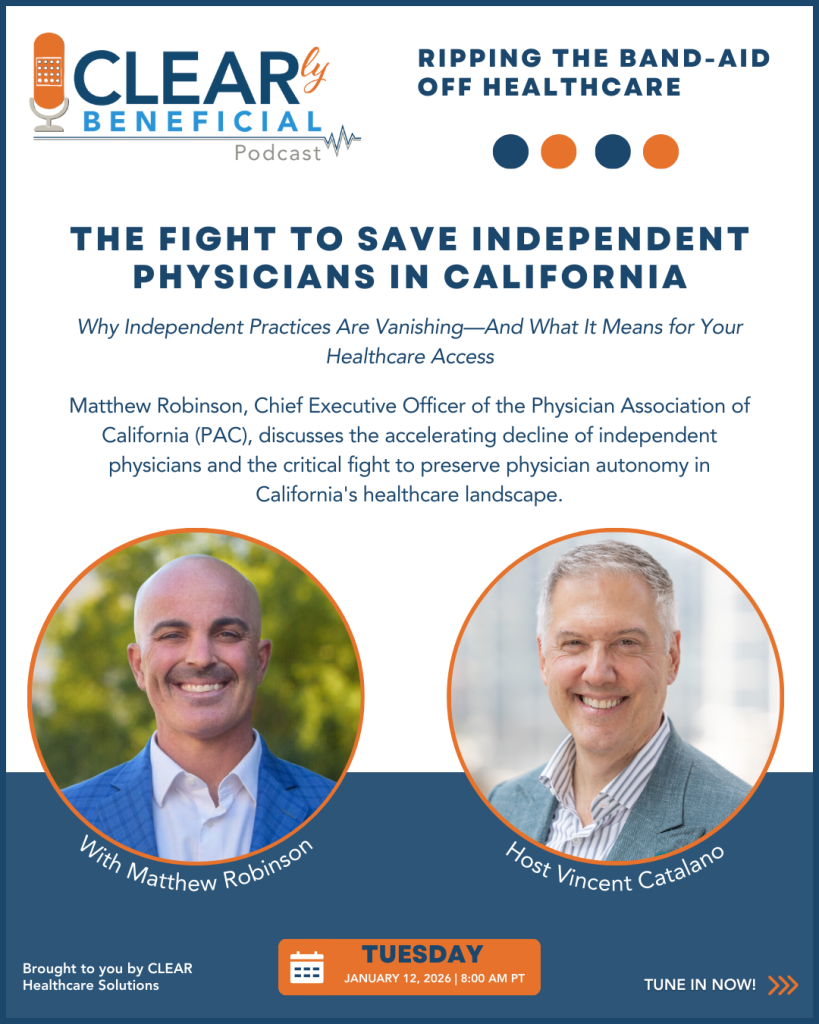
Clip of Vincent Catalano and Matthew Robinson on ‘The Fight to Save Independent Physicians in California’.
Tune into the CLEARly Beneficial podcast with host Vincent Catalano and guest Matthew Robinson. Listen on Buzzsprout, Substack, YouTube or any of your favorite podcast channels.
Learn why independent physicians in California have dropped from approximately 50% of all practitioners to just 33% in approximately 12 years.
That’s not a gradual shift. That’s an accelerating crisis.
Matthew Robinson, Chief Executive Officer of the Physician Association of California (PAC), joined the CLEARly Beneficial Podcast to discuss what’s driving this dramatic decline—and what’s being done to preserve the independent physician model before it disappears entirely.
The Numbers Tell a Troubling Story
Just over a decade ago, half of California’s physicians operated independent practices. Today, only one-third remain.
The rest? Employed by hospital systems, acquired by private equity, or absorbed into large medical groups.
“We represent independent physicians—those who are small business owners with their own practices,” Matthew explains. “And we’re seeing that population shrink rapidly.”
PAC was founded two years ago specifically to advocate for these remaining independent practitioners, focusing on reimbursement issues, administrative burdens, prior authorization challenges, and out-of-pocket costs that disproportionately affect small practices.
How Practice Acquisitions Actually Work
When a physician sells their practice, the terms aren’t always what they expect.
“Typically these are 3-5 year contracts,” Matthew notes. “And often there are multiple sales over time.”
The physician becomes an employee. Autonomy diminishes. The business they built becomes someone else’s asset.
For many doctors facing burnout, administrative overwhelm, and medical school debt exceeding $300,000, employment with benefits and steady income feels like relief rather than loss.
But the downstream effects ripple through the entire healthcare system.
Why This Matters for Everyone
Independent physicians typically:
→ Cost less (no corporate overhead markup)
→ Offer more personalized care (not bound by corporate protocols)
→ Provide better access (flexibility in scheduling and services)
→ Create real competition (keeping larger systems honest on pricing)
When they disappear, healthcare consolidates. Consolidation reduces competition. And reduced competition drives up costs while limiting choices.
“Keeping independent physicians in practice matters for maintaining access to care and cost-effectiveness for health plans,” Matthew emphasizes.
The Medical School Debt Crisis
One driver Matthew highlights: medical school debt that leaves graduates owing more than $300,000 before they ever see their first patient as an attending physician.
Starting an independent practice requires additional capital, business knowledge, and years of building a patient base before achieving financial stability.
Employment offers immediate income, benefits, loan forgiveness programs, and protection from business risks.
“There’s growing interest in educating medical students about running a business,” Matthew says. “But traditionally that’s been completely overlooked in medical education.”
Legislative Wins and Advocacy Work
Despite the challenges, PAC has secured meaningful victories.
California recently passed legislation mandating standardized credentialing application systems—a seemingly bureaucratic achievement that actually matters enormously for reducing administrative burdens and improving patient access.
“Credentialing can take months and delay patient care,” Matthew explains. “Standardized systems streamline the process significantly.”
PAC is also advocating on:
→ Prior authorization reform (reducing delays and denials)
→ Reimbursement equity (ensuring independents aren’t disadvantaged)
→ Liability insurance costs (which disproportionately burden small practices)
→ Administrative simplification (reducing paperwork and compliance burdens)
The Innovation Paradox
Here’s an irony: venture-funded companies are developing solutions to help physicians improve efficiency and profitability.
But independent physicians often lack the bandwidth to evaluate and implement these innovations.
“How do you evaluate AI scribe vendors?” Matthew asks. “What are the risks of sharing patient data with unproven companies? Independent practices don’t have IT departments to assess this.”
The very efficiency tools designed to help independent physicians survive require resources they don’t have to evaluate and deploy.
Is Concierge Medicine the Answer?
Some physicians are leaving traditional insurance entirely, moving to concierge models where patients pay membership fees for enhanced access.
“For specialties with sufficient reimbursement, this can be appealing,” Matthew notes. “But the time and effort required to evaluate new business models deters many physicians.”
It’s also not viable for all specialties, all geographies, or all patient populations.
The broader debate: Is traditional insurance even providing value anymore, or do we need fundamentally new models for healthcare access?
Supporting Practice Transitions
PAC is working with consultants to develop playbooks and resources for young physicians interested in taking over established practices.
“Senior physicians want to transition. Young doctors need paths to ownership. We’re trying to facilitate those connections,” Matthew explains.
Options include stock purchase arrangements, gradual buyouts, and structured transitions that benefit both parties.
But these require business acumen, legal guidance, and financial planning—skills most physicians never developed during medical training.
What Comes Next
PAC is launching its own podcast and preparing resources for independent physicians on marketing, online presence, and practice management best practices.
They’re monitoring California’s Office of Healthcare Affordability, a new entity that may significantly impact how healthcare costs are regulated.
And they’re continuing advocacy work on the legislative and regulatory issues that make or break independent practices.
“Independent physicians need representation,” Matthew says. “They’re competing against massive systems with dedicated lobbyists and government relations teams. Someone needs to fight for their interests.”
Why You Should Care
Even if you’re not a physician, this matters.
The doctors you see, the choices you have, the costs you pay, and the quality of care you receive all connect directly to whether independent physicians survive or disappear.
Healthcare consolidation changes everything.
And once independent practices are gone, they won’t come back.
Listen to the full conversation with Matthew Robinson on the CLEARly Beneficial Podcast:
About Matthew Robinson:
Matthew Robinson serves as Chief Executive Officer of the Physician Association of California (PAC), an organization founded to represent and advocate for independent physicians operating as small business owners. PAC focuses on reimbursement, administrative burdens, prior authorization, liability insurance costs, and supporting practice sustainability.
About Vincent Catalano and CLEAR Healthcare Solutions
Vinny Catalano is Founder & CEO of CLEAR Healthcare Solutions, a consulting firm specializing in medical practice improvement, employee benefit strategy, point solution go-to-market strategy, expense reduction, and healthcare and insurance education. With over 23 years of industry experience, Catalano leverages extensive relationships and expertise to bring fresh perspectives to healthcare and business challenges.
About The CLEARly Beneficial Podcast
The CLEARly Beneficial podcast rips off the band-aid on healthcare and explores the future of benefits with industry innovators. Whether you’re an insurance broker, HR professional, employer, or engaged professional, the podcast delivers straight talk and actionable insights from someone with decades in the trenches. The show takes a solution-oriented approach, featuring conversations with healthcare CEOs, authors, innovators, and leaders driving positive change across industries. New episodes are released weekly on all major podcast platforms.
For more information, visit www.clearhcs.com or connect with Vinny Catalano on LinkedIn at www.linkedin.com/in/vcatalano.
This episode is brought to you by HealthNEXT. HealthNEXT helps employers build cultures of health and well-being that reduce healthcare costs, enhance workforce productivity, and create sustainable competitive advantages through data-driven population health strategies.
Disclaimer: This content is for educational purposes only. Please discuss your specific situation with your health benefits administrator or insurance provider for personalized guidance.