


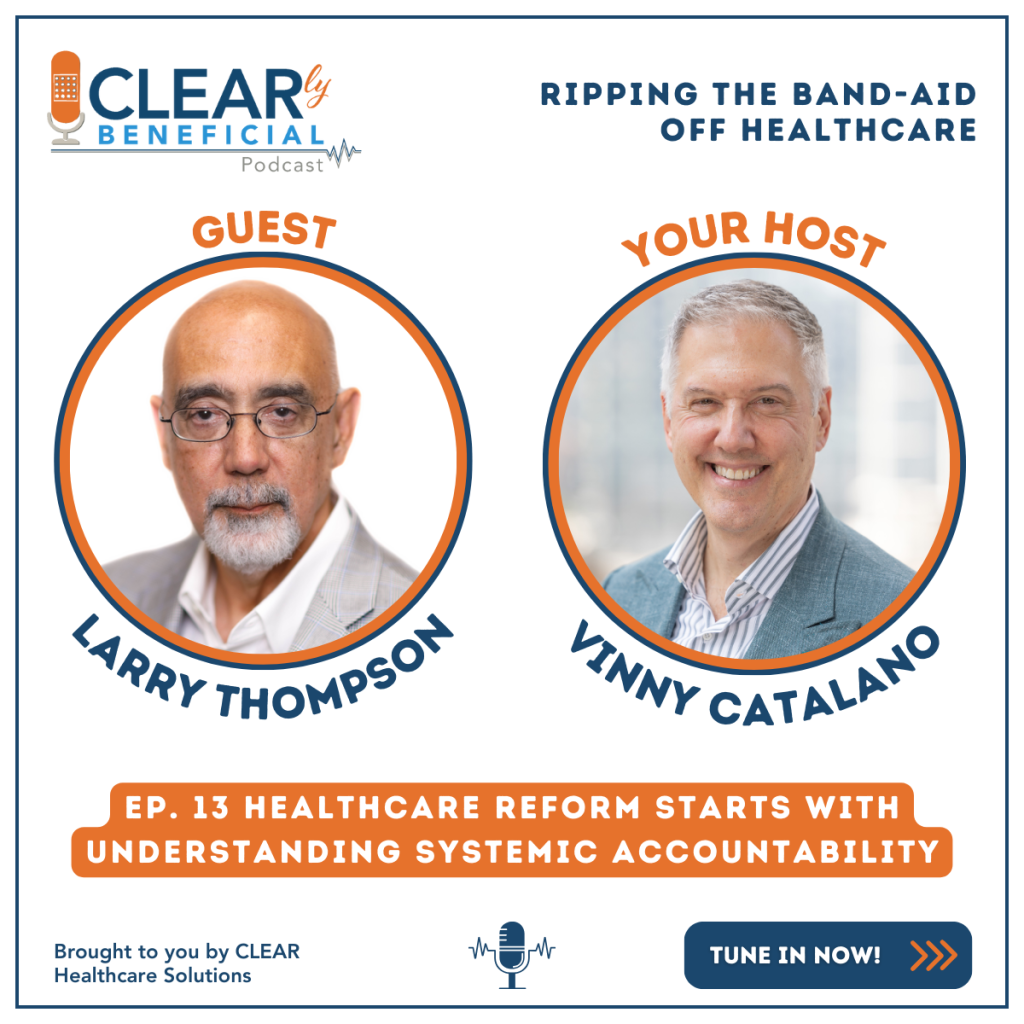
Understanding Healthcare Reform: What Industry Leaders Know About Building Better Systems
Clip of Vincent Catalano and Larry Thompson on ‘Who’s Really Paying Too Much’.
Tune into the CLEARly Beneficial podcast with host Vincent Catalano and guest Larry Thompson. Listen on Buzzsprout, Substack, YouTube or any of your favorite podcast channels.
What does it really take to improve healthcare? According to industry veterans with decades inside the system, meaningful reform starts with something surprisingly simple: understanding how the system actually works.
In a recent episode of The CLEARly Beneficial Podcast, host Vincent Catalano sat down with Larry Thompson, CEO of Benefit Systems Inc., to discuss the foundation for creating better healthcare outcomes—understanding the financial incentives that shape decisions throughout the industry.
Thompson brings substantial credibility to the conversation. His 35+ years of experience includes leadership roles at Aetna Life & Casualty, HealthAxis, and HealthNow, where he managed over $1 billion in P&L and more than 500 personnel. He’s turned around failing TPAs, driven customer satisfaction to five-year highs, and built Benefit Systems Inc. to maintain 98% customer satisfaction ratings while doubling revenue.
Thompson knows how healthcare operates at the highest levels. And he shares what he’s learned about creating positive change.
Why Independent Perspectives Matter
Catalano launched his podcast to create space for honest healthcare conversations—without the corporate constraints that limit many industry voices. He funds the show independently, takes no vendor compensation, and has no products to sell.
Thompson immediately recognized the value of this approach. During their conversation, he noted that many industry perspectives come with financial incentives that shape messaging, making truly independent analysis increasingly valuable for employers and consumers seeking clarity.
“The important part is that it’s not about trying to sell anything,” Thompson said. “We’ve got to get the word out because we’ve got to make changes, and it’s not going to happen unless people start paying attention.”
This foundation allowed the conversation to explore practical strategies for improvement—starting with how employers can build better broker relationships.
Building Strategic Broker Partnerships
Thompson offered straightforward guidance on creating productive broker relationships that align incentives with employer interests.
“When brokers prioritize long-term client value over short-term commissions, employers gain strategic advisors who can help navigate complex healthcare decisions,” Thompson explained. “Understanding how the incentives work helps employers ask the right questions about alignment.”
Thompson recommends employers ask their brokers direct questions about compensation structures, carrier relationships, and how different plan designs affect broker income. These conversations help build transparency and trust in the partnership.
The goal isn’t confrontation, it’s creating relationships where everyone’s interests align around reducing costs and improving outcomes for employees.
Leveraging PBM Transparency for Savings
PBM (Pharmacy benefit management) represents a significant opportunity for employers who understand how to negotiate for transparency, according to Thompson.
He walked Catalano through how PBMs operate and explained why greater visibility into pharmacy costs creates opportunities for substantial savings. When employers understand the full picture, including spread pricing, rebate structures, and formulary decisions, they can negotiate better arrangements.
Thompson’s practical advice includes demanding pass-through pricing where actual drug costs are visible, requiring audit rights in contracts, and working with consultants who understand PBM contracting well enough to negotiate effectively.
Knowledge creates power in these negotiations. Employers who invest time in understanding PBM business models consistently achieve better contract terms and lower pharmacy costs.
The Power of Stakeholder Alignment
Thompson emphasized that improving healthcare requires engagement from all stakeholders working toward shared goals rather than competing interests.
Insurance companies, hospital systems, pharmaceutical manufacturers, PBMs, brokers, consultants, TPAs, and government regulators each play important roles. “When these groups work toward shared goals rather than competing interests, meaningful progress becomes possible,” Thompson noted. “Understanding how different stakeholders contribute helps identify opportunities for better alignment.”
This perspective shifts the conversation from blame to opportunity. Rather than fighting against the system, employers can work strategically within it by understanding stakeholder motivations more clearly, they can make better choices benefiting everyone involved.
Value-Based Care: Pathways to Implementation
The conversation explored value-based care models and their potential to improve healthcare delivery while controlling costs.
Value-based care shifts payment from volume to outcomes, aligning provider incentives with patient health rather than procedure counts. When implemented effectively, this approach rewards providers for keeping patients healthy rather than for treating illness.
Thompson acknowledged that the transition involves challenges: provider adaptation to new payment models, increased administrative complexity, and data infrastructure requirements. But understanding these challenges helps innovators and early adopters create successful pathways for implementation.
He also emphasized the importance of distinguishing real value-based care, which involves significant financial risk sharing, from arrangements that simply add quality bonuses to traditional fee-for-service models.
Employers asking the right questions about value-based care arrangements can identify programs genuinely designed to improve outcomes versus those offering incremental modifications to existing approaches.
Supporting Healthcare Innovation
Thompson and Catalano discussed how innovation gains traction in healthcare and what employers can do to support promising solutions.
“New approaches must prove value and navigate complex existing systems,” Thompson explained. While change happens incrementally, he goes on to say, “understanding the barriers helps innovators design better implementation strategies and helps employers identify promising solutions early.”
Rather than waiting for industry-wide transformation, forward-thinking employers can work with proven innovators to pilot new approaches and demonstrate what’s possible.
Practical Steps Employers Can Take Now
Thompson offered concrete guidance for employers ready to take action:
- Build Understanding – Invest time in learning how healthcare payment systems work. Knowledge enables better questions and decisions.
- Demand Transparency – Insist on pass-through PBM pricing, claims data access, and audit rights in vendor contracts.
- Engage Financial Leadership – Bring CFOs into benefits strategy discussions. Financial perspectives add valuable discipline to healthcare spending decisions.
- Ask Better Questions – Question broker compensation structures, PBM contracts, and vendor relationships to understand incentive alignment.
- Explore Alternatives – Consider reference-based pricing, direct primary care, centers of excellence, and other options beyond traditional networks.
- Use Available Tools – Leverage emerging transparency regulations and price comparison resources as they become available.
- Maintain Realistic Expectations – Meaningful improvement requires sustained effort and willingness to try new approaches. Look for steady progress rather than overnight transformation.
A Book Focused on Solutions
Thompson shared that he’s writing a book examining each healthcare stakeholder’s role and opportunities for positive contribution.
“Rather than assigning blame, my goal is fostering understanding about how financial incentives shape decisions throughout the industry,” Thompson explained. “When stakeholders understand the system more clearly, they can make better choices that benefit everyone.”
The book aims to help industry participants understand their own roles and identify opportunities for creating better outcomes.
Why Understanding Matters
Healthcare costs continue consuming larger portions of company budgets. For many employers, healthcare spending rivals or exceeds profit margins, making cost management a financial imperative.
But effective management requires understanding. Employers who grasp how healthcare systems work, who gets paid and how, and where opportunities exist for better arrangements consistently achieve better outcomes than those operating without this knowledge.
Thompson spent 35+ years inside healthcare’s power structures. He explains how systems operate, including opportunities within his own industry, providing guidance most employers never receive.
The message is clear: understanding comes first. Then meaningful change becomes possible.
Moving Forward
Thompson offered realistic optimism about what focused efforts can achieve in healthcare improvement.
He acknowledged that systemic change requires collaboration across multiple stakeholders. But he believes individual organizations taking informed action can demonstrate what’s possible and inspire broader adoption of better approaches.
For employers seeking to manage healthcare costs more effectively, or consultants trying to better serve clients, Thompson’s insights provide practical guidance rarely available.
The path forward starts with understanding—then builds toward action, improvement, and ultimately better outcomes for everyone involved in healthcare.
About Larry Thompson
Larry Thompson serves as Chief Executive Officer of Benefit Systems Inc. With over 35 years of success providing transformative leadership for start-up, turnaround, and joint venture initiatives in the health insurance industry, Thompson is a nationally recognized industry expert with intimate experience in every facet of healthcare delivery systems. His career includes high-profile positions with Aetna Life & Casualty, Dun & Bradstreet Plan Services, HealthAxis, and HealthNow, where he consistently exceeded goals and expectations in challenging situations. Thompson has managed over $1 billion P&L and more than 500 personnel operating nationally. His achievements include turning around a large TPA from significant multi-year losses, driving Blue large group customer retention to five-year highs, and founding Benefit Systems Inc. to achieve and maintain 98% customer satisfaction ratings and 100% referral rate while doubling revenue.
About Vincent Catalano and CLEAR Healthcare Solutions
Vincent Catalano is Founder & CEO of CLEAR Healthcare Solutions, a consulting firm specializing in medical practice improvement, employee benefit strategy, point solution go-to-market strategy, expense reduction, and healthcare and insurance education. With over 23 years of industry experience, Catalano leverages extensive relationships and expertise to bring fresh perspectives to healthcare and business challenges.
About The CLEARly Beneficial Podcast
The CLEARly Beneficial podcast rips off the band-aid on healthcare and explores the future of benefits with industry innovators. Whether you’re an insurance broker, HR professional, employer, or engaged professional, the podcast delivers straight talk and actionable insights from someone with decades in the trenches. The show takes a solution-oriented approach, featuring conversations with healthcare CEOs, authors, innovators, and leaders driving positive change across industries. New episodes are released weekly on all major podcast platforms.
For more information, visit www.clearhcs.com or connect with Vincent Catalano on LinkedIn at www.linkedin.com/in/vcatalano.
Disclaimer: This content is for educational purposes only. Please discuss your specific situation with your health benefits administrator or insurance provider for personalized guidance.