


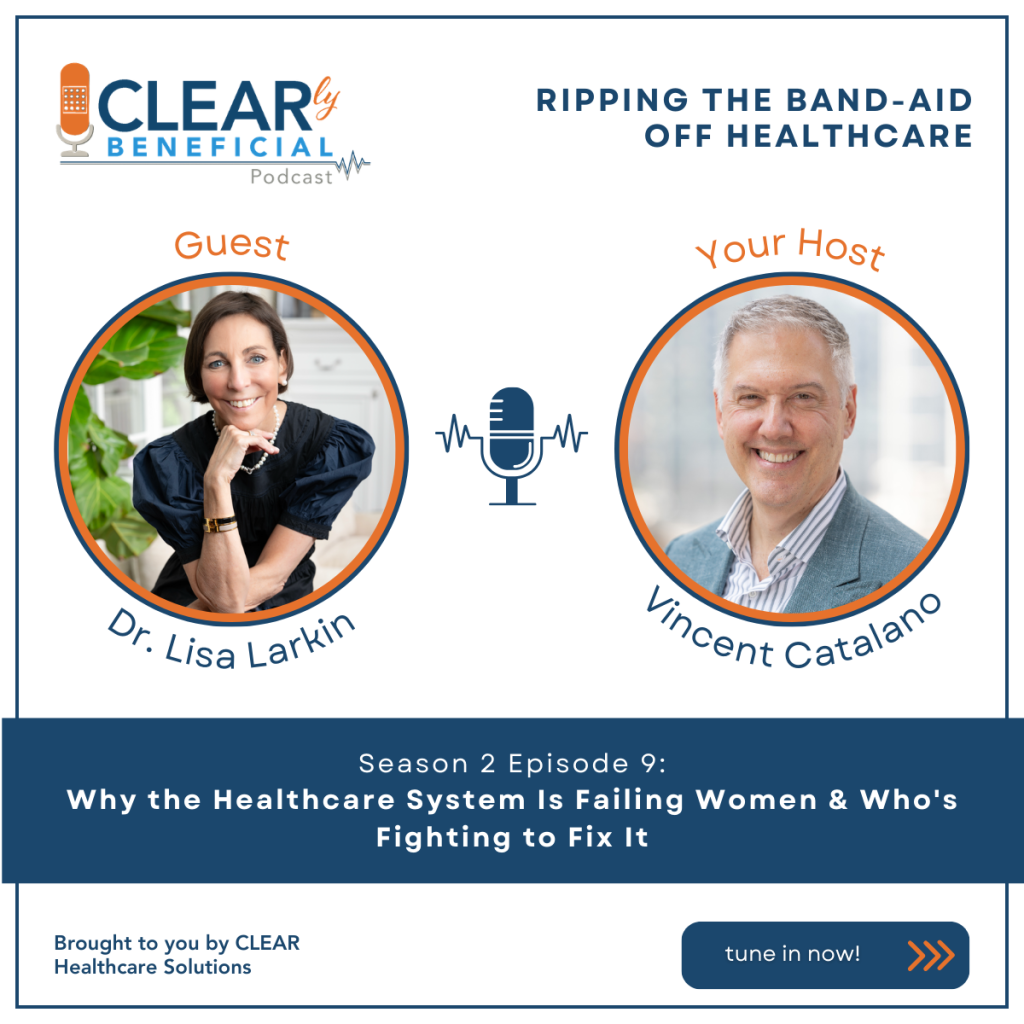
Clip of Vincent Catalano and Dr. Lisa Larkin on Why the Healthcare System is Failing Women and Who’s Fighting to Fix It
Tune into the CLEARly Beneficial podcast with host Vincent Catalano and guest Dr. Lisa Larkin. Listen on Buzzsprout, Substack, YouTube or any of your favorite podcast channels.
Why the Healthcare System Is Failing Women and Who’s Fighting to Fix It
A conversation with Dr. Lisa Larkin, MD, FACP, MSCP, IF, Founder and CEO of Ms. Medicine
Tune into the CLEARly Beneficial Podcast with your host, Vincent Catalano, and guest, Dr. Lisa Larkin. Listen on Buzzsprout, Substack, YouTube or any of your favorite podcast channels.
The healthcare system was not built for women.
That’s not a political statement. It’s a clinical one. For decades, the default patient in medicine has been male. Drug trials, dosing guidelines, diagnostic criteria, medical education itself, all built around a male baseline. And midlife women, navigating perimenopause, menopause, hormonal shifts, and a cascade of downstream health consequences, have been paying the price.
Dr. Lisa Larkin has spent 35 years watching it happen. And then she decided to do something about it.
Dr. Larkin, a nationally recognized women’s health internist, founder and CEO of Ms. Medicine, and Past President of The Menopause Society, joined Vincent Catalano on The CLEARly Beneficial Podcast to talk about what is broken in women’s healthcare, why it stays broken, and what a better system actually looks like.
The conversation is equal parts diagnosis and blueprint.
35 Years of Watching the System Fail
Dr. Larkin did not leave academic medicine because she was disillusioned. She left because she had a clearer picture of what good care could look like, and she wanted to build it.
After years on faculty at the University of Cincinnati College of Medicine, directing the UC Health Women’s Center, and running specialized programs in menopause, sexual health, and executive women’s health, she made a decision in 2016 that surprised some of her colleagues: she walked away from academia to open a concierge practice.
Concierge Medicine of Cincinnati (CMOC) was founded on a simple but radical premise: patients deserve more than seven minutes with their doctor. They deserve time, continuity, and a physician who actually knows them.
“The traditional insurance-based system forces physicians into a volume model that is fundamentally incompatible with comprehensive care,” Dr. Larkin explains. “You cannot properly evaluate and treat a woman in midlife in a rushed appointment. You need time to listen, to ask the right questions, to make connections across systems. Concierge medicine gives us that time.”
Today, CMOC is Cincinnati’s largest independent primary care and women’s health practice, with 10 female physicians and clinicians across three locations. Dr. Larkin continues to practice clinically herself.
Building a National Standard
One practice in Cincinnati was not going to change the system. So in 2019, Dr. Larkin founded Ms. Medicine.
Ms. Medicine is a national healthcare management organization with a specific mission: to improve the care of midlife women by establishing a national network of specialty-trained women’s health primary care and gynecology clinicians, all working in a direct care, concierge delivery model.
The network now includes 30 women’s health specialists practicing across 17 locations in 10 states, with two additional affiliates set to launch in early 2026.
“What we’re building with Ms. Medicine is a replicable standard of care,” Dr. Larkin says. “Physicians who join the network get infrastructure, support, and the ability to practice medicine the way they were trained to practice it. Patients get access to clinicians who genuinely specialize in their needs across the lifespan.”
The model addresses two simultaneous failures: the patient experience and the physician experience. Both are broken in the current system. Insurance-based primary care drives physicians toward burnout by demanding volume over quality, and drives patients toward undertreatment by rationing time.
“We have brilliant physicians who went into medicine to help people, and the system has ground them down into claim processors,” Dr. Larkin observes. “Ms. Medicine is about giving them their practice back.”
The Menopause Care Crisis
Of all the gaps in women’s healthcare, menopause care may be the most consequential and the most neglected.
Menopause affects every woman who lives past midlife. It brings with it a range of symptoms, from hot flashes and sleep disruption to cognitive changes, mood shifts, cardiovascular risk, and bone loss, that can persist for years or decades. Left untreated, these symptoms affect quality of life, professional performance, and long-term health outcomes.
And yet the majority of women never receive adequate care.
“Most physicians receive little to no training in menopause management during medical school or residency,” Dr. Larkin explains. “So you have this massive population of women in midlife who are symptomatic, who are suffering, and who are going to their doctors and either being dismissed or being given incomplete information.”
The consequences reach well beyond the clinic. Research consistently links untreated menopause symptoms to reduced productivity, increased absenteeism, and higher rates of workforce exit among women in their peak earning years. For employers, this is not just a health issue. It is a workforce issue.
“Employers are starting to connect the dots,” Dr. Larkin notes. “When your most experienced employees are struggling with symptoms that are treatable, and you haven’t provided access to care, that has a direct impact on your organization.”
HERmedicine: Education at Scale
The clinician knowledge gap is not just a problem for patients. It is a structural barrier to improving care at any scale. You cannot build a better system if the people delivering care lack the training to provide it.
In 2024, Dr. Larkin founded HERmedicine, a nonprofit organization with a mission to advance the care of women through evidence-based education for both women and the clinicians who treat them.
The growth has been remarkable. HERmedicine now reaches clinicians across all 50 states and 37 countries through free weekly virtual education sessions. An average of 160 clinicians participate live each week.
“We designed HERmedicine to be accessible and free because we wanted to remove every possible barrier to participation,” Dr. Larkin says. “If a physician in a rural area can join a live session on their lunch break and walk away with new clinical tools, that is care improvement that reaches patients we might never otherwise touch.”
The nonprofit also runs biweekly consumer-focused sessions called HERtalks, aimed at empowering women with trusted, evidence-based health information. The dual model, clinician education and patient education running in parallel, is designed to close the gap from both directions.
What Employers and Benefits Professionals Should Know
For the employers, HR leaders, and benefits advisors who make up a significant portion of The CLEARly Beneficial Podcast audience, this conversation offers a framework that goes beyond clinical detail.
Midlife women represent a significant and growing share of the workforce. The cost of their undertreatment is measurable and largely invisible in traditional benefits analysis. Untreated menopause symptoms do not show up as a line item. They show up as performance reviews, turnover statistics, and disability claims.
Dr. Larkin and Vincent discussed several dimensions of this problem that benefits professionals rarely encounter in the traditional insurance conversation:
- The limits of telemedicine and AI as substitutes for in-person, relationship-based primary care in complex hormonal conditions
- Why access to a menopause-certified specialist is meaningfully different from access to a general practitioner
- How direct care and concierge models can be incorporated into employer benefit strategies
- The return on investment of proactive women’s health access versus reactive treatment of downstream conditions
“This is about workforce strategy as much as it is about healthcare,” Vincent observes in the episode. “The employers who figure this out early are going to have a retention and culture advantage over those who don’t.”
The Larger Picture
Dr. Larkin’s work spans four interconnected organizations: Concierge Medicine of Cincinnati, Ms. Medicine, HERmedicine, and her ongoing national leadership in women’s health policy and education. The common thread across all of them is a refusal to accept the status quo.
She is not waiting for the insurance system to reform itself, for medical schools to revise their curricula, or for policymakers to mandate better coverage. She is building the infrastructure for a better system in parallel, and doing it at scale.
“There is an enormous unmet need, and it is not going away on its own,” Dr. Larkin says. “Every year that passes without adequate menopause care is a year of preventable suffering. We are not going to wait.”
For Vincent, the episode represents exactly the kind of conversation The CLEARly Beneficial Podcast was built for.
“Dr. Larkin is doing what the best people in healthcare do: identifying a real problem, building a real solution, and refusing to let the system’s inertia stop her,” he says. “Every employer listening to this should be asking what they can do to support women’s health access in their workforce. The answer is not complicated. The willingness to act is the first step.”
About Dr. Lisa Larkin
Dr. Lisa Larkin, MD, FACP, MSCP, IF, is a nationally recognized women’s health internist with over 35 years of clinical experience. She is the founder and CEO of Ms. Medicine, a national healthcare management organization with 30 women’s health specialists across 17 locations in 10 states, and founder and CEO of Concierge Medicine of Cincinnati. She is the founder and Executive Director of HERmedicine, an education nonprofit reaching clinicians in all 50 states and 37 countries, and a Past President of The Menopause Society. Dr. Larkin has been featured in CNN, the New York Times, O Magazine, NPR, and SiriusXM’s Doctor Radio.
About Vincent Catalano & CLEAR Healthcare Solutions
Vincent Catalano is the CEO of CLEAR Healthcare Solutions and host of The CLEARly Beneficial Podcast. With over 23 years of experience in the employee benefits and insurance brokerage industry, including time at Arthur J. Gallagher, Catalano founded CLEAR Healthcare Solutions to provide independent, unbiased healthcare benefits consulting. The CLEARly Beneficial Podcast features solution-oriented conversations with healthcare innovators, industry leaders, and benefits professionals. His unique position as an independent consultant allows him to have frank conversations about healthcare issues that corporate-employed professionals cannot address. New episodes release weekly on Tuesdays at 8:00 AM across all major platforms. Learn more at www.clearhcs.com.
Disclaimer: The information provided in this podcast is for educational and informational purposes only and should not be construed as legal, financial, or professional advice. Listeners should consult with qualified professionals regarding their specific situations.
Listen to the podcast here or on your favorite platform:
- Buzzsprout: https://www.buzzsprout.com/2526095
- Substack: https://clearlybeneficialpodcast.substack.com/
- YouTube: https://www.youtube.com/@CLEARlyBeneficialPodcast