


Healthcare Reform Is Coming. A Top Healthcare CEO Just Told Me When the Reckoning Hits.
Healthcare reform is coming, whether the industry plans for it or not. The only real question is how. Most people in this business are betting the current system limps along for another decade. Paul Markovich isn’t so sure.
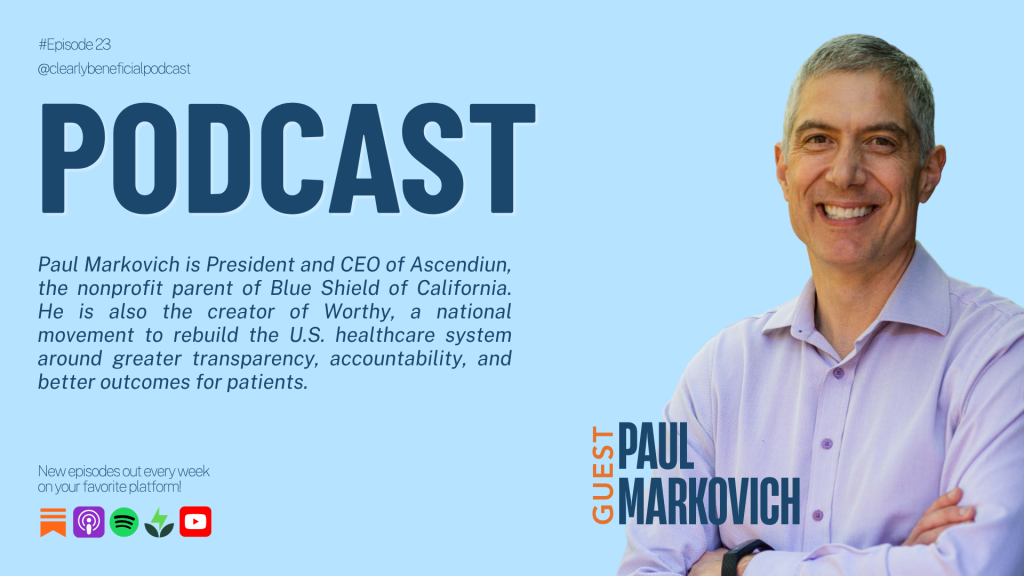
Paul is my friend, and we go back more than 20 years. He is President and CEO of Ascendiun, the nonprofit parent of Blue Shield of California. When I got him on the show, I asked him the question I actually wanted answered: if we keep going the way we’re going, where does this end?
His answer stuck with me, and I’ve been doing this a long time.
The Break He Sees Coming
He sees a tipping point coming. Not a slow drift, a break.
“You do not have a sustainable business,” he told me, “if you’re operating in an unsustainable industry.”
Here’s what he means. Healthcare costs keep climbing at a rate nobody can absorb, not employers, not families, not the state or federal government. Something eventually gives. And when a system finally snaps under that kind of pressure, the fix doesn’t get written calmly by the people who understand it. It gets imposed in a crisis, by people reaching for the biggest lever they can find.
Paul’s fear isn’t reform. It’s reform done in a panic. A heavy-handed solution, dropped on the industry all at once, that hurts the very people it’s meant to help.
That’s the reckoning. And his read is that we’re closer to it than most of us want to admit.
He Built the Alternative. It’s Called Worthy.
But here’s why I wanted you to hear from Paul specifically. He doesn’t stop at the warning. He’s spent years building the alternative.
It’s called Worthy.
The mission is simple to say and hard to do: a healthcare system worthy of our family and friends, and sustainably affordable for everyone. Not a system that works because you happen to know someone who can make a call. One that works for everyone, every time.
Paul is convinced you can’t get there by tinkering. It takes structural reform, the kind that only happens when Washington actually moves. New rules on how we pay for care. A real digital health record for every American. Drug pricing that makes sense. A system-wide budget that ties healthcare inflation to something a working family could actually keep up with.
Why He Won’t Blame the Hospitals
Take hospitals. It’s easy to make them the villain. Paul won’t.
“There’s too much complaining about the way hospitals behave,” he said, “when in fact we’ve set up a system to encourage them to behave that way.”
We pay hospitals to do more, so they do more. We hand them 160,000 billing codes and act shocked when they use them.
Paul’s fix flips the incentive. Instead of paying a hospital for every test, admission, and procedure, you pay it a budgeted, risk-adjusted amount to keep a whole population healthy, and you reward it for quality and service rather than sheer volume. Do that, and a hospital stops chasing revenue it has to invent and starts competing on the thing patients actually want.
The numbers show why this is urgent. Hospital revenues have grown roughly two and a half times over 20 years, to about $1.5 trillion, compounding north of 8 percent a year. As Paul puts it, most hospitals don’t have a revenue problem. They have a cost problem.
Then There’s the AI Arms Race
If you want a picture of how broken the incentives already are, look at what AI is doing to your claims.
Paul described hospitals where, in one case for 18 months, nearly every patient got coded as septic, whether or not they were being treated for sepsis. Others coded routine cases as severe bleeding with none of the treatment you’d expect if that were true. The software learns to find the highest-paying label and reach for it every time.
So the health plans answer with their own AI to push back. Paul calls the result a stalemate, and he’s blunt about where it leads. You can fight the coding to a draw, but the hospital has every financial reason to invent the next workaround, and the one after that. Playing whack-a-mole against that kind of self-interest is not a strategy. It’s just proof that the payment model itself has to change.
The Proof Is Already on the Books
And here’s the part that should give you hope. This isn’t theory. Blue Shield already proved a piece of it.
They walked away from the traditional pharmacy benefit manager model and rebuilt it from scratch. The result in 2025: pharmacy costs running about three points below the national trend, and more than $100 million in savings in a single year.
Want to know how broken the old way is? Paul told me about one drug, Humira, with a list price near $7,000 a month. The actual revenue the maker collected was a little over $2,000. That means roughly $5,000 a month was disappearing into the machinery of rebates, fees, and middlemen. For one drug.
Fix the plumbing, and the savings are real.
On Medicare for All, He Asks a Better Question
We covered more than I can fit here, including his honest take on Medicare for All, which is neither the cheerleading nor the fearmongering you usually get. He calls the phrase “a bit of a bumper-sticker slogan” and says the versions floated so far don’t fix the things that actually drive cost. But he won’t slam the door either. A proposal that genuinely addressed those drivers, he says, would be “worthy of our attention and debate.”
His point: stop arguing about the label and start asking whether any proposal, under any name, actually fixes how we pay for care, price drugs, and hold the system accountable. That’s the test.
What This Means for You
So why does this matter to you, whether you run HR, sign the checks as a CFO, or advise clients as a broker?
Because the tipping point Paul describes doesn’t announce itself. It shows up in your renewal. The window to build something better on purpose is open right now. It won’t stay open forever.
That’s not doom. That’s a reason to move.
I sold Blue Shield my whole career, and today I’m a happy member myself. So I don’t say this lightly: this is one of the most useful conversations on healthcare reform we’ve had on the show.
Give it a listen. It’ll be time well spent. And if it makes you think, tell me what you’d fix first in the comments.
Ciao, Vincent
Want more conversations like this one? Vincent covers topics like these weekly on the CLEARly Beneficial Podcast.
- Buzzsprout: https://www.buzzsprout.com/2526095
- Substack: https://clearlybeneficialpodcast.substack.com
- YouTube: https://www.youtube.com/@CLEARlyBeneficialPodcast
About Paul Markovich
Paul Markovich is President and CEO of Ascendiun, the nonprofit parent of Blue Shield of California, Blue Shield Promise Health Plan, Altais, and Stellarus. He is also the creator of Worthy, a national movement to rebuild the U.S. healthcare system around greater transparency, accountability, and better outcomes for patients. A 25-year Blue Shield veteran, Markovich served as President and CEO of Blue Shield of California from 2013 to 2024, growing the organization to more than 6 million members and over $25 billion in annual revenue. A North Dakota native and Rhodes Scholar, he holds a master’s degree in philosophy, politics and economics from the University of Oxford and a bachelor’s in international political economy from Colorado College, where he played Division I hockey.
About Vincent Catalano & CLEAR Healthcare Solutions
Vincent Catalano is the founder and CEO of CLEAR Healthcare Solutions and host of The CLEARly Beneficial Podcast. With over 23 years of experience in employee benefits and insurance brokerage, including time at Arthur J. Gallagher, Catalano founded CLEAR Healthcare Solutions to provide independent, unbiased healthcare benefits consulting. His unique position outside corporate constraints allows him to have frank conversations about healthcare issues that others can’t address. New episodes release weekly on Tuesdays at 8 a.m. across all major platforms. Learn more at www.clearhcs.com or read more on the blog.
Disclaimer: The information provided in this podcast is for educational and informational purposes only and should not be construed as legal, financial or professional advice. Listeners should consult with qualified professionals regarding their specific situations.